

ABOUT HBAG
A community response rooted in coexistence.
Hermanus is a place where wild fynbos and urban life meet. Keeping that relationship healthy is a shared responsibility.

UNDERSTANDING BABOONS
Intelligent, social and vital to the fynbos ecosystem.
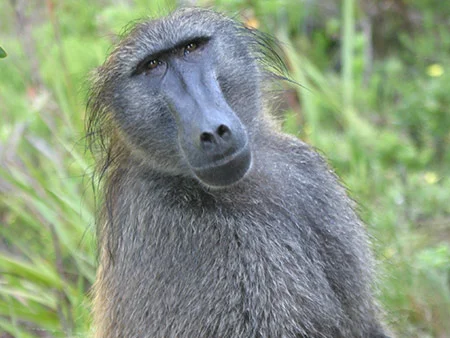
Baboons play a crucial role in our unique fynbos ecosystem as seed dispersers. They show the same range of emotions as humans, mourning family members, squabbling over food, caring for each other and living within clear troop roles.
Understanding their behaviour helps us appreciate these smart animals while managing our interaction with them in wild and urban areas.
COMMUNITY ACTION
Making raiding unrewarding
In Hermanus, we enjoy living close to nature. It is our community’s responsibility to manage baboons respectfully when they enter urban space, for the safety and peace of people and wildlife. The only way to modify raiding behaviour is to limit access to easy food sources.
With effective baboon monitoring and preventative measures at every residence, baboons learn that raiding is not worth it. This change is possible only when each person stays informed, secures their home and reduces the attractiveness of their property to baboons.
MUNICIPAL ACTION
Coordinated and adaptive management.
The Overstrand Municipality Baboon Management team uses audible deterrents along the town edge to help keep troops out of urban areas, and less-loud tools in town to move them out as safely as possible. The strategy adapts to troop dynamics, behaviour and food availability.
Tools are used in accordance with relevant permits and the Strategic Baboon Management Plan developed by CapeNature and DEAD&P. The focus remains on keeping the Voëlklip troop out of town for extended periods, for the wellbeing of residents and baboons.
Overstrand Municipality action
To best manage troop behaviour in urban areas, the Overstrand Municipality’s Baboon Management team uses tools such as bangers and screamers as an audible deterrent along the edge of town to try to prevent the troop from coming into town, as well as primers and gelblasters to move the troop out of town as best as possible.
Screamers and bangers are used between the town and the mountain range that runs the length of Voëlklip when the weather is favourable. These tools help move the troop up the cliffs and over the mountain, with no more than three or four used at any given time. Primers are used in-town as a less loud audible deterrent.
Bangers and screamers are used in accordance with relevant permits and aligns with best-practice baboon management, as outlined in the Strategic Baboon Management Plan developed by CapeNature and DEAD&P and used by other wildlife and baboon management organisations.
The management strategy remains focused on keeping the Voëlklip troop out of town for extended periods, for the wellbeing of both residents and the baboons. Naturally, changes in behaviour, troop dynamics, and food availability are expected. The management team continues to adapt to these changes, as flexibility is essential for effective and responsible baboon managemen
HBAG’s STORY
Initiated by residents in 2019.
HBAG began with a small committee that believed the escalating suburban baboon challenge could be addressed proactively. Our goal is to facilitate collaboration that protects the wellbeing of both people and baboons.
Our Aims
1. Promote coexistence and awareness
Foster understanding, tolerance and shared responsibility through awareness, education and communication.
2. Strengthen accountability and governance
Advocate for effective management, waste control and enforcement of relevant bylaws, while reporting welfare concerns.
3. Enhance communication and research
Serve as a liaison between the municipality, service providers and residents, and encourage safe, humane interventions.